

Stop‑press (April 2026): InkjetMall has officially discontinued the Piezography K6/K7 ink lines. With K7 no longer produced, EBONI‑7 now stands as the only actively maintained seven‑shade monochrome inkset available for modern Epson printers. This wasn’t planned – it’s simply where the timeline has landed – but it gives my EBONI‑7 project a new historical context. – https://piezography.com/piezography/
Original Article
By the time I had absorbed Roark’s philosophy – the simplicity, the openness, the “use what you have and understand it deeply” mindset – I found myself looking at my own hardware with new eyes.
My Epson R3880 has eight ink-channels, so suddenly, I am no longer limited to four or six shades.
Roark had always reserved a channel for a blue or cyan toner, not because he needed it immediately, but because he understood that monochrome printing isn’t always monochrome: Sometimes you want a whisper of coolness; Sometimes you want a split tone; Sometimes you want the option to shift the print’s emotional temperature without rebuilding the entire system. So I decided to keep one channel in reserve.
I have the same channel budget Cone used for K7.
If Roark’s question was “What is the best monochrome system I can build with the channels available?“, then my question became: “What is the best monochrome system I can build with seven channels available?“
I wanted the same things I had wanted from the beginning:
- multi‑shade carbon
- engineered neutrality
- tonal architecture
- predictable behaviour
- a system I could understand, document, and reproduce
And now, for the first time, the hardware and the philosophy aligned.
Where Roark had to compromise – four shades, then six – I don’t.
Where Roark had to tune dilutions perceptually, I can afford to be mathematical.
Where Roark had to stretch a single pigment across too few channels, I could give each shade room to breathe.
So I set out to build the open‑source equivalent of a K7 inkset.
Not a clone or imitation, but a geometric, seven‑shade carbon ladder built from first principles.
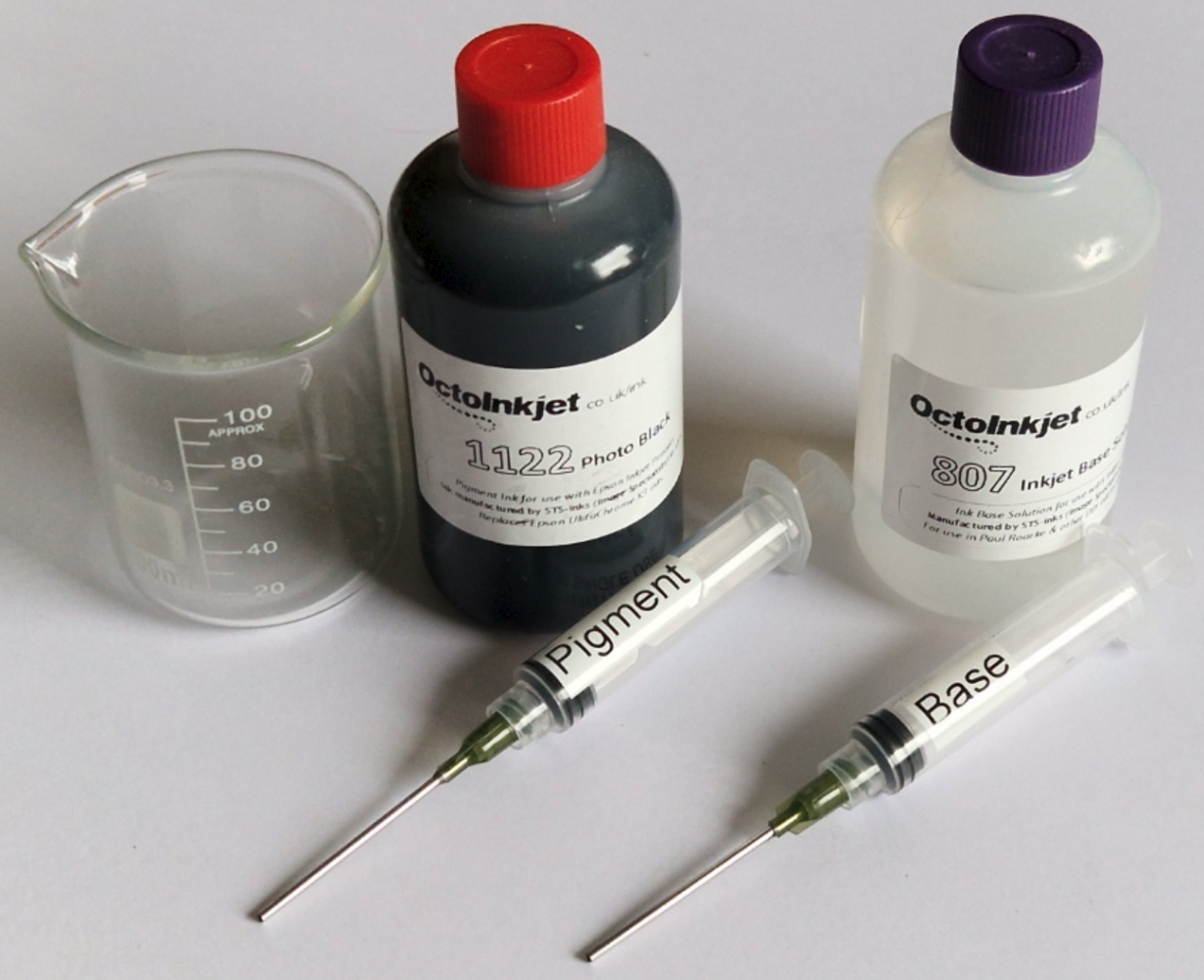
After trying a few different mathemaical progressions, I settled on a refined Three‑Quarter‑Stop ladder.
a ratio of: r=2^{0.75}
Starting at 100% and stepping down 0.75 stops each time, gives:
- 100%
- 59.5%
- 35.4%
- 21.0%
- 12.5%
- 7.4%
- 4.4%
A ladder that runs from full‑strength carbon down to roughly 4% – pale enough for smooth highlights, dark enough for deep shadows, and mathematically consistent from top to bottom.
Eboni‑6 jumped from 100% to 30%. That’s a 1.7‑stop drop. It worked, but it carried a real risk of shadows blocking‑up because the darkest shade had to switch on too early. EBONI‑7 fixes this by inserting a 59% shade into the set, which stabilises the deep midtones and keeps the shadows open.”
This is the ladder Roark would have built if he’d had more channels to play with.
This is the ladder Cone could have published if his system had been open.
This is the ladder that finally gave me what I had been chasing since the beginning.