

Shadow moves in ways light can’t. It creases across skin, pools in folds, and offers both concealment and invitation. In fine art nude photography, shadow does more than sculpt form—it shapes mood, suggests what’s unsaid, gives space for vulnerability. I often return to low-key lighting because it allows for tension between what is visible and what is purposely left in darkness.
Low-key lighting demands trust, patience & intention. It asks the subject to yield part of themselves—to step into light knowing much will remain unlit. It asks the photographer to work with subtlety: to place the light with care, to watch for detail, to feel when the balance is right. The highlight must not burn; the shadow must not swallow.


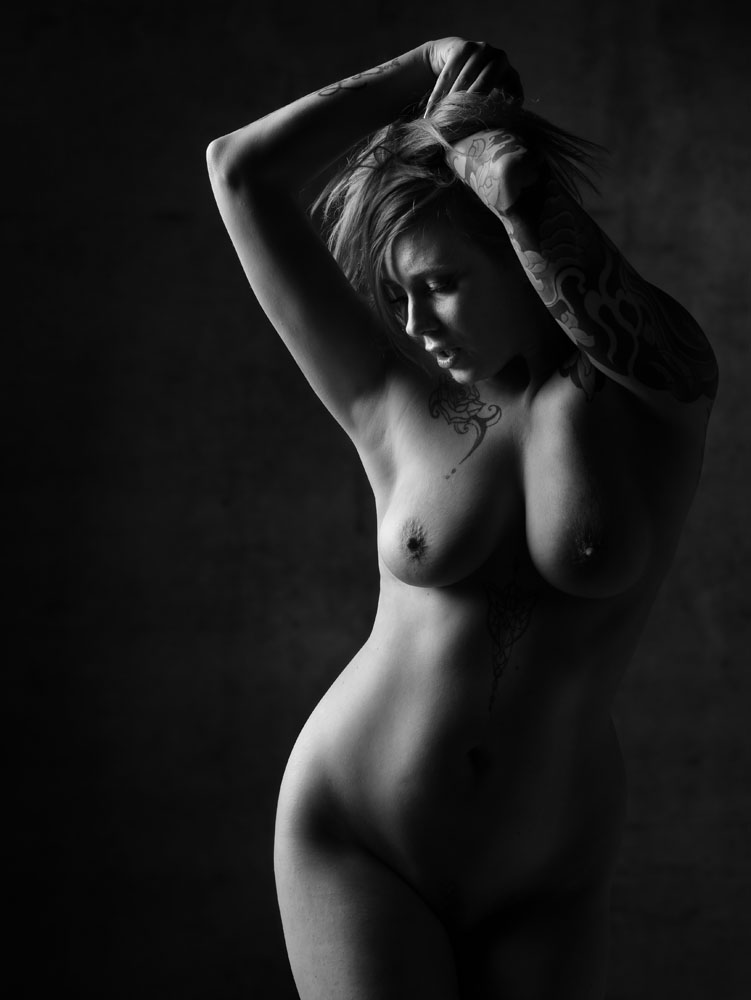
Shadow has narrative. When a body recedes into it, when fingers fade into darkness, when textures become whispers, the viewer begins to wonder. What lies beyond? What is hidden? That curiosity is part of the emotional pull. It is not about teasing or eroticism—though those are often falsely assumed—it is about breathing room, silence, mystery. It is about seeing less so you can feel more.
From a technical perspective, low-key lighting changes everything. With fewer lights and more control over fall-off, every reflector, every flag matters. Shadows must be painted with consideration. Negative fill, flags, modifiers, all become tools of mood. A fabric backdrop that absorbs light instead of reflecting it. The shape of the light source—softbox, bare bulb, feathered edge—makes huge difference. And post-production must preserve shadow textures. Clarity in shadow often makes the difference between an image that feels “deep” and one that feels flat.
But the emotional landscape is what draws me back. There is something about watching a model become form in darkness that feels like watching something sacred. In scenes like these, I feel less like I am photographing naked bodies, and more like I am recording moments between light and dark, between seeing and not seeing. The tension holds meaning.
Shadow also offers safety. For the subject, allowing parts of the body to fade into darkness gives permission to be partially hidden. That partial hiding can bring comfort, preserve dignity, let intimacy emerge without exposure. When everything is lit, there can be pressure—on the body, the skin, the gaze. When shadow is embraced, the subject can decide not just how much to show, but how to exist in that showing.
Influences show themselves in every frame. I think of Caravaggio and Rembrandt, of their ability to pull drama from darkness, to let a single candlelight or a window throw shape across flesh and cloth. I think of Weston, his abstraction of form and texture, where shadow limits but also defines. I think of contemporary photographers whose light dissolves at the edges, whose subjects seem to float between figure and memory. Their work reminds me that shadow is not about loss but about presence.
In my practice, I have made mistakes. In one shoot, I over-lit the backdrop in attempting to get texture; the shadow lost its depth, forms flattened, and the image lost its emotion. In another, I under-exposed hoping for mood, but skin tones became muddy and detail vanished. Those failures taught me more than successes. They taught me about the fragile thresholds where light and shadow meet—that moment when balance shifts either way.
Because the silent parts of an image matter. What we don’t see often invites longer looking than what is fully revealed. A shoulder fading into black, a garment trailing off, edges vanishing—all invite participation. The viewer becomes part of completing the image. They supply what is missing with their imagination.
Emotion in low-key is not just about darkness. It is about contrast: contrast of tone, texture, feeling. It is about waiting in light, listening. It is about giving rather than showing. Sometimes the quietest images are those most alive.
For me, low-key lighting is not a style I choose for effect. It is a language. It allows me to speak of vulnerability and strength, of what is held back as much as what is given. It is a way to photograph not just bodies, but moments: gestures poised between light and dark, presence that lingers in edges, memory that whispers.
When I return to shadow lighting, I do so knowing its power: the power to shape mood, to protect, to reveal in small increments. I set up light not to dominate, but to guide. I sculpt absence as much as presence. And in that sculpting, I hope to create images that resonate—images that invite silence, that linger after the shutter clicks, that ask the viewer to look twice, to feel, to remember.